Having thus excluded conversation and desisted from study, he had neither business nor amusement. His ideas, therefore, being neither renovated by discourse nor increased by reading, wore gradually away, till at last his anger congealed into madness.
A somewhat lost but never forgotten pivotal piece of historical drag queen media has been restored and made available on Netflix.
The Queen is a 1968 documentary about the previous year’s Miss All-America Camp Beauty Pageant, a competition for drag queens. The film was groundbreaking for its honest depiction of drag queens in the moments between the pageantry. Even in the far less accepting America of the late ‘60s, it received some positive reviews from outlets like the New York Times after premiering at the Cannes Film Festival.
But like many niche films from decades ago, it hasn’t been readily available for the masses. So while it likely paved the way for so much of future drag culture, from RuPaul to ballroom houses, its gone unseen by many.
Netflix tweeted on Thursday that the iconic documentary had finally been restored, color corrected, and released on the streaming platform.
The announcement came alongside a series of tweets sharing the fascinating history of The Queen, with a short dive into why it holds such an important place in LGBTQ history.
“Before RuPaul launched the careers of over 100 drag queens and Elektra Wintour read the ballroom houses of POSE to ashes, THE QUEEN, a 1968 documentary about a 1967 drag pageant, debuted at the Cannes Film Festival providing an almost unprecedented look at queer culture,” the Netflix thread began.
Before RuPaul launched the careers of over 100 drag queens and Elektra Wintour read the ballroom houses of POSE to ashes, THE QUEEN, a 1968 documentary about a 1967 drag pageant, debuted at the Cannes Film Festival providing an almost unprecedented look at queer culture. (thread)
Directed by Frank Simon, the film came to be largely thanks to Jack Doroshow, aka Miss Flawless Sabrina. It showed the performer at the height of her power, a queen amongst queens, who ran an operation of about 100 people that put on as many as 50 pageants per year across America
But in addition to the successes of Sabrina, buried within the doc is the inciting incident that led to the house-ballroom scene, where the art of voguing would emerge.
These two things make THE QUEEN, which until now has never been streamable, an indelible part of queer history
Netflix’s Twitter account points out that one of the big reasons The Queen is so important is because it shows people living their truth in a time when they were more ostracized for it than most of us can remember.
“This was a time before the pivotal Stonewall Uprising, a time where drag was often still criminalized–Sabrina was reportedly arrested over 100 times for crossdressing,” one tweet reads, referencing the pageant’s mistress of ceremonies, Miss Flawless Sabrina.
This was a time before the pivotal Stonewall Uprising, a time where drag was often still criminalized — Sabrina was reportedly arrested over 100 times for crossdressing.
Still, “One grows fond of all of them,” the New York Times wrote of the queens in its initial film review.
On its surface, this cinéma vérité-style documentary is a chronicling of the Andy Warhol-judged 1967 Miss All-America Camp Beauty Contest. For that event, 28 drag performers converged on Manhattan. But as a part of the process, the film provides insight into the LGBTQ+ community.
In a particularly heartbreaking look into the discrimination that these men faced in their time, the tweets feature a video in which the contestants, outside of drag makeup and costume, share stories about the army turning away either them or their friends for being visibly gay.
Like DRAG RACE after it, in multiple scenes contestants appear chatting about their lives and issues that impact them directly; Acceptance from family and friends, the conflation between drag and trans identities, as well as the presence of queer people in the military.
In this way, THE QUEEN is almost unprecedented, allowing drag queens to speak in a forum that did not judge, mock, or criticize them. In fact, if criticisms were lobbed at anyone, it is the viewer that is in the hot seat.
But what The Queen is most known for is, as Netflix writes, the “epic reading session by Crystal LaBeija” captured on film. When LaBeija failed to win the crown, which she, likely accurately, perceived to be due to racism and favoritism, she left the stage and later gave a verbal lashing to the camera and then to Miss Flawless Sabrina for the choices the pageant made.
But the moment from the film that has become the most memorable, referenced on shows like TRANSPARENT and by celebrities like Frank Ocean, is an epic reading session by Crystal LaBeija. Aja, infamously recreated the moment in a DRAG RACE Snatch Game challenge.
LaBeija was the reigning Miss Manhattan at the time, and one of only a few Black queens who had ever won Queen of the Ball, a prestigious title. At the time, queens of color were routinely short shrifted, snubbed in favor of their white counterparts.
So, when Crystal was called as third runner-up for the title of the 1967 Miss All-America Camp Beauty Pageant, it seemed a repeating of a history she knew too well. She walks offstage, in the middle of the awards, never to walk another pageant in the white-centric circuit again.
As the final scene of the film — and of that segment of Crystal’s drag career — she lets loose a blistering read, first to the camera, and then to Miss Flawless Sabrina herself. It’s a sight to behold.
This moment has been referenced by current LGBTQ media again and again. It also ultimately led to LaBeija breaking off and doing her own thing, which in turn led to the creation of “houses” in ballroom, as well as voguing.
“I’m beautiful and I know I’m beautiful” she yells at one point.
With that chapter of her life LaBeija began to get involved with a series of Black-centered balls. In a bit of marketing genius credited to her friend Lottie, she hosted one of her own under the "House of LaBeija."
The format of "houses" hosting balls quickly was replicated, and these groups, which were almost exclusively Black at the time, began to form, becoming surrogate families for members.
The art of voguing would be created and nurtured in these families.
Today the House of LaBeija still lives on. After Crystal LaBeija, the house was run by Pepper LaBeija — who some believe was the first runner-up in the now infamous 1967 pageant. Pepper received her kudos in another landmark film, PARIS IS BURNING, which gave a look into ballroom
Since that 1991 work, the scene has grown into an international, bustling community with over 50 houses. Though POSE shows a fictionalized narrative set in the 80s and 90s, other shows like My House and YouTube channels like Ballroom Throwbacks show the scene today.
So it is on the shoulders of THE QUEEN that all of these projects stand, and arguably a large part of RuPaul’s legacy — in a 2019 Vogue profile Ru revealed that a 1976 lip sync by Crystal LaBeija was the first drag performance he saw.https://www.vogue.com/article/rupaul-interview-may-2019-issue …
The result: THE QUEEN is an inextricable part of queer history, preserving Flawless Sabrina, who was the RuPaul of her time, as well as the moment that the ballroom community began to split off and become something all its own.
The Queenis now available to stream on Netflix in the U.S., the U.K., Canada, and Australia after being restored by Kino Lorber and the Harry Ransom Center at the University of Texas.
Wednesday, January 29, 2020
There is no Earthly way of knowing… which direction we are going. There is no knowing where we’re rowing, or which way the river’s flowing. Is it raining? Is it snowing? Is a hurricane a’blowing? Not a speck of light is showing so the danger must be growing. Are the fires of hell a'glowing? Is the grisly reaper mowing? YES!
80 per cent of homosexuals sent to the notorious Nazi concentration camp died there - some finding love among the horror or saving the lives of others first. That’s worth remembering this Holocaust Memorial Day.
2019-01-27
Words: Hugh Kaye This is an updated version of this article. With thanks to Dr Anna Hájková and her research into the queer history of the Holocaust for University of Warwick, and as previously published in German newspaper Tagesspiegel.
Adolf Hitler planned a 1000-year Reich. It lasted all of 12 years but in that short time some 100,000 gay men were arrested. About half of them were sent to prison but as many as 15,000 were deported to concentration camps. By 1945, more than 40,000 such camps were in operation and homosexuals were sent to any number of them.
But a relatively small number were sent to the most notorious of them all: Auschwitz.
Of the 97 gay men known to have been sent to Auschwitz, 96 were German. Scholars have unearthed the fate of 64 of them: 51 died in the camp. That’s 80 per cent; a higher number than any other category of “undesirable” except for Jewish deportees.
It’s important to know that Auschwitz was, in fact, three camps. The main camp, Auschwitz I, began functioning in May 1940. Based near the remote town of Oswiecim, in Poland, this is where you’ll see the gate with the infamous Arbeit Mach Frei (work sets you free) sign above it. Although there was a makeshift gas chamber here in the early days, the camp was mainly a prison facility created in a former army barracks. Prisoners were forced to work and faced the prospect of barbaric experiments by SS doctors as well as sterilisation and castration. Executions were commonplace.
Construction of a second camp began in October 1941. This was Birkenau which was to become the Nazis’ major killing centre and the largest cemetery in the world. A third camp, known as Monowitz opened a year later. German companies, in particular IG Farben and Buna, set up factories here, using inmates as slave labour.
Unlike Jews and Roma, gay men were not as a rule sent direct to Birkenau. They were not, as such, marked for immediate death. However, they suffered unusually cruel treatment in the concentration camps, not only from the SS -- they had their testicles boiled off in water and were given the most dangerous and arduous work under the Extermination Through Work programme - but also from fellow prisoners who saw them as the lowest of the low. They were isolated, and every attempt that they made at contact with other prisoners brought them under suspicion of “initiating promiscuous relations.”
Little wonder that the rate of suicides among gay men was much higher than for an other category of prisoner. Throughout the whole concentration camp system, it was at least 10 times higher and there’s no reason to believe it would have been any lower at Auschwitz. And that figure is probably a conservative one, given that the Nazis didn’t always bother to register such deaths.
It is known that on 20 January 1942, there were 22 gay men in the main camp, and by August that year there were 28 of them in the entire Auschwitz complex.
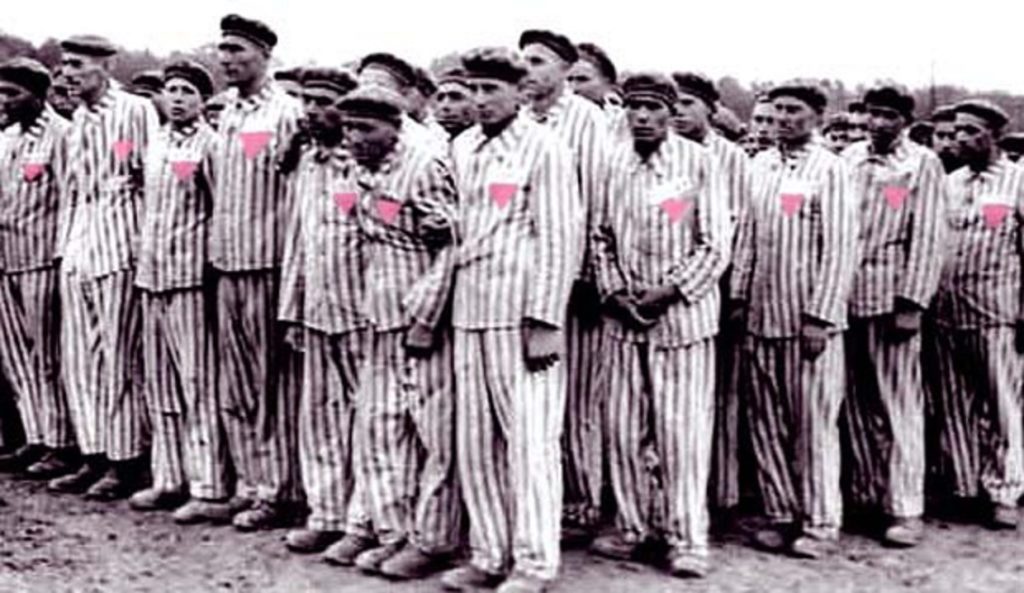
But some gay men were Jewish as well and their fate was often decided by whether they arrived at the camp wearing the yellow star of David (for Jews) or the almost-as-notorious pink triangle that homosexuals were forced to sew on to their clothes.
Fredy Hirsch was an athlete and PE teacher. He was Jewish and gay. He was born in Aachen, Germany, in 1916. He moved to Czechoslovakia to escape Nazi persecution, living with his lover Jan Mautner, a slightly older medical student, between 1936 and 1939 - as reported by Der Tagesspiegel.
Fredy organised and ran youth camps and looked to help young Jews hoping to emigrate to Palestine. When the Nazis invaded Czechoslovakia in 1939 and banned Jews from public places, Hirsch found a playground where the youngsters could still exercise and 18 of his youngsters managed to escape to neutral Denmark.
He was sent to Theresienstadt concentration camp, a place the Germans called the “model ghetto,” at the end of 1941. Mautner was deported there a few months later. Hirsch immediately began looking after a group of children, making sure they exercised and, more importantly in the squalid conditions, stayed clean, even holding hygiene competitions.
All the children were forced to work and Fredy tried to ensure they had “easier” jobs such as in the vegetable fields. He, of course, spoke German and this helped to forge reasonable relations with the guards even though he was Jewish and openly gay. On occasion, this helped him to remove children from transports from Theresienstadt to the death camps.
However, he pushed his luck too far and having tried to make contact with a group of young new arrivals at Theresienstadt, he was sent to Auschwitz in September 1943 in a transport with 5,000 others – 300 of whom were 15 years old or younger.
Fredy ended up in a “family camp” within Birkenau. It was usual for children not to be sent straight to their deaths but somehow Fredy became the children’s carer. He ensured they had lessons, organised activities and managed to get better food and warmer barracks for them. He even managed to persuade guards to hold the daily roll call inside rather than have the youngsters standing for hours in the freezing cold. But Fredy was not immune from hardship and on at least one occasion was viciously beaten when one of the children slept through the roll call.
Fredy Hirsch served as supervisor of the children's block at the family camp at Auschwitz II-Birkenau
Another transport of 700 children arrived at Birkenau in December 1943 – along with Jan Mautner, although he never saw Fredy again. Hirsch persuaded the authorities to allocate a second barracks for the younger children, those between the ages of three and eight so that they could put on a performance of Snow White for the SS.
Within the family camp, the mortality rate after the first six months was about 25 per cent – in Hirsch’s barracks there were almost no deaths at all.
Fredy soon became part of a resistance movement within the camp and learned that a large group of the children was to be gassed. Although it is not known for sure what happened next, it is thought Hirsch refused to be parted from his young charges despite his status a work-fit man meaning he would have likely been spared death. Some scholars think he took his own life via an overdose - or that Jewish doctors induced an overdose themselves in order to prevent him causing an uprising that could have jepardised their own lives. What is sure is the children were murdered on the night of 8 March 1944 and their bodies burnt. Fredy’s body was cremated on the same day. He was 28.
In 2008, a memorial plaque was laid outside Hirsch's childhood home in Aachen, Germany.
One of the survivors of the family camp in Theresienstadt said: “There was no one who was so self-sacrificing, [or] devoted to the children.” And although, he was air-brushed out of history by the communists in Czechoslovakia and some survivors after the war because of his homosexuality, in 2016 the Lord Mayor of his home town in Aachen described him as "one of the most important sons of the city, if not the best known.”
And Czech musician Zuzana Růžičková, who worked as a teacher's assistant at the children's barracks at Auschwitz, credited Hirsch with saving her life. He told her to lie about her age, saying she was 16 because younger children usually went straight to the gas chambers.
Acclaimed czech musician and Auschwitz survivor Zuzana Růžičková credited Fredy Hirsch with saving her life
Many years later, she helped organise a monument for him. At the dedication, she said: "We hope that when the last of us who knew him have passed away, future generations will stand before this tablet and say: 'He must have been a good, brave and beautiful person'.”
Fredy's partner Jan survived Auschwitz, as well as at least one other camp and being shipped back to Theresienstadt. He became a doctor and found a new partner. But he did not escape unscathed: he had contracted tuberculosis in the camps and died in Prague in 1951.
Kitty Fischer was 17 when she sent to Auschwitz in 1944 because she was Jewish. On arrival, she was sent to have her head shaved. Terrified and bemused, she met a portrait painter from Munich. They made him clean the toilets seven days a week, 10 hours a day “as a better use of his brush.”
Seeing, his pink triangle, Kitty asked what it meant. When he said he was a gay, she didn’t understand. He explained the he was a homosexual. Kitty had no idea what the word meant and asked whether it was a religion, which made the young man, who’d been sent to the camp with his partner in 1940, laugh.
Some time later, the man brought her and her sister two hot jacket potatoes. He continued to smuggle food to Kitty every day. “He contributed to my survival, that is a fact,” she said.
The artist approached her again a month later. He was being moved to another camp and warned her that there was to be a selection the next day, when the Nazis would send a large group to the gas chambers. The gay man told her that a company was looking for weavers to work outside the camp. Tell them you can weave, he said. Lie.
“I was so young,” Kitty added. “He knew what was going to happen to me, I didn’t.” She did as she was told and survived, being liberated at the factory in May 1945. She went on to be a run a number of shops in Australia before moving to the Kings Cross neighbourhood of Sydney where she witnessed the terrible toll HIV/Aids was having on the gay community there. She spent the rest of her life offering emotional and psychological support to those suffering with the conditions. She died in 2001.
Nothing more is known about her saviour.
Karl Gorath was 26 when he arrived at Auschwitz. He’d been denounced by a jealous former lover and arrested under the Nazis’ Paragraph 175 which outlawed homosexual acts - including kissing and hugging - and remained in force in parts of Germany until 1969.
He was sent to the concentration camp at Neuengamme, near Hamburg. He had been training to become a nurse so was put to work in a prisoner hospital at a sub camp. But having refused to reduce food rations to Polish inmates, he was punished by being transported to Auschwitz. Given that his crime was now seen as political, he was forced to wear a red triangle, and tattooed with the number 124630.
He worked in the sick bay of Auschwitz I until nine days before the camp was liberated when he was transported in freezing cold weather in an open freight car to Mauthausen, near Linz in what was Upper Austria. The journey took 11 days.
Karl Gorath was 26 when he arrived at Auschwitz. The anti-gay law he was arrested under remained in place until 1969
He was moved again as Allied armies closed in on Nazi Germany and was finally liberated by the Americans on 6 May 1945.
In his memoirs, he claimed that two younger Poles, Tadeusz and Zbigniew, became his lovers in the camp. Incredibly, he goes on to say: “I had my own room as a block supervisor this is where I spent the happiest days of my life, with Zbigniew.” He adds that only once in his life did he experience such deep love from another man, and that it was “here, in the camp, among all the misery surrounding us, never before, and never again—never more: I met the love of my life in Auschwitz.”
Tadeusz and Zbigniew both died in Auschwitz.
You would hope that Karl’s troubles ended after his liberation but that’s not the case. Gay holocaust survivors could be re-imprisoned for "repeat offences", and were kept on lists of "sex offenders". Under the Allied Military Government of Germany, some homosexuals were forced to serve out their full terms of imprisonment, regardless of the time spent in concentration camps.
Karl was re-arrested in March 1946, sent for trial and sentenced to five years in jail. All appeals for a pardon and clemency were turned down and he wasn’t released until April 1951. As other groups seen as undesirable by the Nazis successfully pursued claims of compensation for their suffering, Karl’s efforts were thwarted on the grounds that he had a “criminal record” and that he had not been persecuted because of his race or belief. Karl continued to face discrimination for being gay long after surviving the horrors of Auschwitz
As recently as May 1975, Karl, then aged 62, was denied a pension because “the period between 1/8/39 to 8/5/45 cannot be recognised as substitute time” for work. In other words, being at Auschwitz wasn’t bad enough!
Appeals against this ruling were all finally dismissed in February 1980. Karl Gorath died in March 2003 at the age of 90. Paragraph 175 was not removed from the statute books in full until 1994.
Ernst Ellson was born in 1904. He was Jewish but arrested in November 1940 after a male prostitute told the police that he was a client. Ernst was jailed for four months after being found guilty of “perverted promiscuity.” He had been under surveillance since 1935.
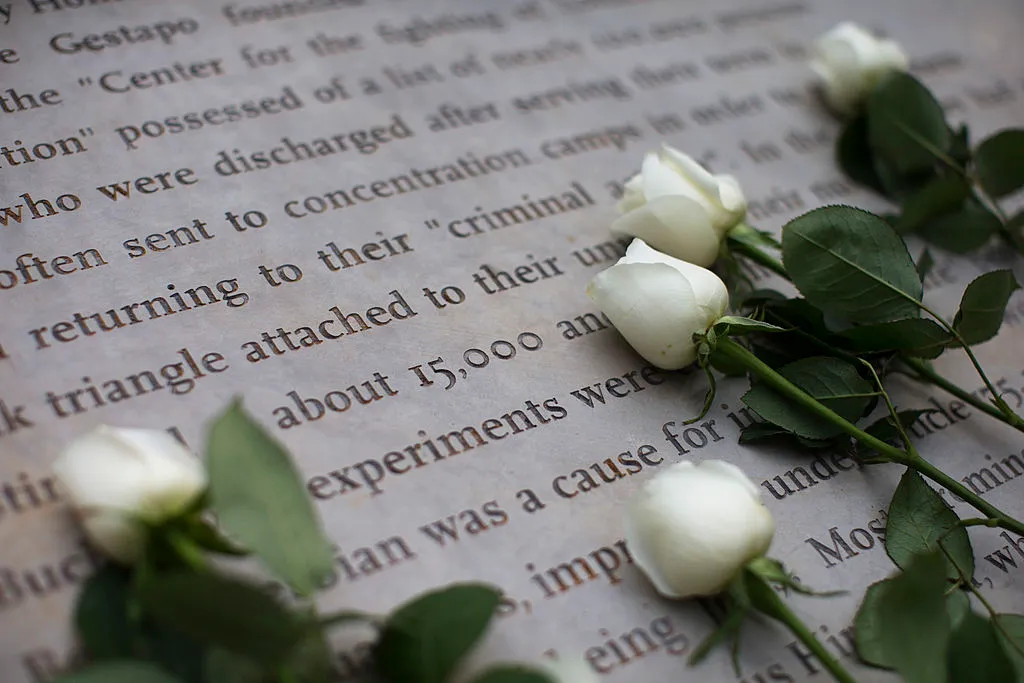
On the day he was released from prison, the Gestapo were waiting for him with an arrest warrant. It stated: “It is to be feared that, if left at large, he will persist in behaviour that is harmful to the national health.” The document was signed by one of the architects of the Final Solution, and the head of the security service, Reinhard Heydrich.
Ernst was sent first to Buchenwald, near Weimar in Germany, where some 56,000 people were to die, then Gross Rosen, which is now part of Poland, where some 40,000 inmates lost their lives. He was deported to Auschwitz on 16 October 1942.
He had lived for 18 months in the first two camps but survived just five weeks in the horrors of Auschwitz.
Manfred Lewin was gay and Jewish. He lived in Berlin and was ordered to be deported in 1942 along with his parents.
Manfred Lewin was sent to Auschwitz at the age of 20
His boyfriend, 19-year-old Gad Beck, got hold of a Hitler Youth uniform and tricked the guards at the detention centre into releasing Manfred, who he said was needed for slave labour. They walked out of the gates together, but Manfred decided he couldn’t leave his family behind and turned back. He was shipped to Auschwitz where he died, aged just 22.
Manfred's boyfriend Gad Beck was one of the last gay survivors of the Holocaust when he died in 2012
Gad survived the war and in an interview in 2000, 12 years before his death, recalled the loss of his "great, great love."
Hermann Bartel was a decorator. He was gay. Sent to Auschwitz on 6 December 1941, he died there on 2 March 1942, aged 41. Erwin Schimitzek was a gay commercial clerk. He was sent to Auschwitz on 22 August 1941. He died there in January the following year. He was 23. Agricultural worker Emil Drews arrived at the death camp the same day and died a few days before Erwin. He was 58.
Gay shopkeeper Max Gergia spent three months at Auschwitz before dying. He was 37. Emil Sliwiok suffered the same fate, he was 28. Waiter August Pfeiffer was deported to Auschwitz, arriving there on 1 November 1941. Aged 46, he died at the end of December. Walter Peters, a doctor, died five days after arriving at the camp. He had just turned 51. Willi Pohl was 35 when he died. He was a textile worker and a gay man. Rudolf von Mayer was a judge. He was gay. He arrived at Auschwitz on 30 May 1941 and died three months later, just days before his 37th birthday. Willi Kacker was 36 when he died. Farmer Oskar Birke was 48. Otto Hertzfeld, 35; butcher Johann Majschek, 53; gardener Franz Ruffert, 39; office assistant Richard Schiller, 41; tailor Josef Klose, 47; electrician Hugo Prabitzer, 40.
All gay. All sent to Auschwitz. All died.
Erwin Schimitzek died in Auschwitz in 1942 aged 23
And there were more – not to mention the countless numbers whose exact fate remains unknown either at the camp or after being transported elsewhere before the end of the war. Gay men; killed simply because they loved another man.
If you take one thing from all this, this Holocaust Memorial Day, maybe it should be that the Nazis didn’t just kill individuals. As historians have pointed out, one of the gay men who died might have gone on to invent something incredible, they might have become a great diplomat or leader who avoided another murderous war, the younger ones might have gone on to become scientists or doctors, who found a cure for cancer, dementia, ebola, heart disease, or HIV. The common cold – who knows?
The Nazis didn’t just kill individuals: they killed the future.
... and more. Click the links above to read stories from the trail.
What We’re Up Against
“Don’t make us go West Virginia on you.”
Working class struggle runs through our veins. Our ancestors waged the bloodiest labor conflict in American history right here in these hills, over the right to unionize. At Blair Mountain, thousands of mineworkers--Black, white, and immigrant--marched together against company rule. They wore red bandanas to identify themselves in battle. 100 years later, teachers, school service personnel, and communications workers donned those same red bandannas to lead the country’s unions in a national strike wave. Thank goodness.
When workers win, everyone benefits. Who’s responsible for the 40-hour work week, employer health insurance, child labor laws, and paid sick days? Union workers. When did we have the strongest middle class? When union participation was at its highest.
With union membership gutted, it is no surprise that our state now faces historic levels of inequality and child poverty. Compared to our parents generation, jobs now are harder to get and harder to keep. They also pay less. It used to be that parents could raise their kids on the wages from one salary, just a generation ago. Now it can take 3 jobs, just to get by.
Bottom line: workers have become more and more productive, but we have received a smaller and smaller share of the pie. And you can feel it.
This story is true for so many of us. And things are even worse for the women who were out front in this recent strike wave: in most professions, women are compensated less than men for the same job. For Black and brown women, compensation is even worse. Solidarity means equal pay for equal work, no matter who you are.
The Good Old Boys at the Capitol want to blame us for the state of the economy--Jim Justice tells us that we just have to work harder, that we have to want a better economy more. We want it plenty. The truth is, the reason so many of us are struggling to get by is that more and more of our wealth--the wealth that we make--gets shipped out-of-state to CEOs, shareholders, and corporate executives.
It doesn’t have to be this way.
We will run the most pro-labor campaign in West Virginia history, on the side of all working people. That means we will fight to reverse so-called “Right to Work” and restore the Prevailing Wage. But it also means going farther. Every other state in the country is chasing the Amazons and Wal-Marts of the world, aiming to make their states the most welcoming to CEOs and the shareholders of out-of-state corporations. Our state has tried that.
Wal-Mart is the second largest employer in West Virginia, and our people are still piecing our incomes together. The way we create an economy that works in our favor is not by chasing those same companies who keep extracting our wealth, but by playing by our own rules and putting workers and local businesses first.
Our Plan
Eliminate so-called “Right-to-Work.” Make it so that every worker who benefits from union representation is pitching in their fair share for that representation.
Restore the Prevailing Wage. Ensure that workers employed under a public work contract are fairly compensated.
Institute collective bargaining for public employees. Ensure that teachers, school service personnel, and all government employees have the right to organize. Ensure that all public employee unions have office space and paid time to conduct union duties.
Strengthen and enforce the West Virginia Jobs Act. Make it so out-of-state companies are held accountable to hire locally. Explicitly prefer union companies in state contracts.
Pass Wage Protection Laws. Ensure that workers' pay is prioritized over creditors pay in the case of bankruptcy.
End “at will” employment beyond a probationary period.
Establish a Fair Workweek for West Virginia, that accounts for predictability pay, split-shift pay, on-call pay, and an advance-notice provision. Workers lose real money, time, and child care options when they cannot schedule their work lives.
Pass the strongest laws in the country related to protecting the right to organize, and strike:
Pass an excess compensation tax where large corporations are charged a tax based on the ratio of their lowest paid employee to their highest paid employee. Corporations with larger wage disparity will pay more, incentivizing fairer pay. No CEO should make more than 500x what a cashier makes. Revenue will help fund a State Bank for West Virginia (see forthcoming plan).
Raise the minimum wage to $15 an hour for all employees. No one should work a 40 hour work week and wonder how they’ll support their family. Out-of-state corporations with millionaire and billionaire CEOs can and should pay workers a living wage. For small businesses, the backbone of our economy, this can be harder. We plan to implement this change gradually, off-setting with tax cuts for small, local businesses so that these changes are paid for by large businesses that can afford them.
Strengthen, police, and prosecute anti-trust, wage theft, bankruptcy, and other corporate crime statutes. Establish a 50-member Corporate Crime division in the State Police to investigate and bring charges against corporate criminals, focusing especially on unpaid payroll and use taxes by out-of-state corporations.
Create a “West Virginia Certified” Program. Help more of our state’s wealth stay here by prioritizing union shops (through Project Labor Agreements), local businesses, and women- and minority-owned businesses in all state contracts.
Establish an Earned Income Tax Credit. This is one more step in shifting the tax burden away from workers and families and onto the shareholders who benefit from our work (the details of this plan are included in our forthcoming Tax Plan).
Open Workers Centers across the state. Workers Centers are places where workers can file grievances, gain legal help, register to vote, find support for organizing their workplaces, and gain training and technical assistance for starting worker-owned cooperatives or Employee Stock Ownership Plans (ESOPs). We will also re-write our code to make West Virginia the best place in America to start a worker-owned cooperative or ESOP, betting big on our own people.
Guarantee Earned Sick Days for every worker. Make it so no one has to come to work sick.
Pass a Family Leave Program. Provide partially-paid time off for workers to care for a loved one. Over time, expand the program to become the first Universal Family Care program in the country.
Pass the nation’s strongest Equal Pay for Equal Work Act. Ensure that women are paid fairly, and that pregnant workers are not discriminated against.
Ensure that every worker has equal protection under the law. End discrimination in employment (as well as housing), on the basis of gender or sexuality.
Protect Nurses and Certified Nursing Assistants (CNAs). Pass safe staffing regulations, end mandated overtime (except for emergencies), and engage nurses and CNAs in efforts to reduce paperwork and streamline regulations--so they can spend more time caring for patients, and less time pleasing bureaucrats.
How We Pay For It
Most policies on this list require legal changes, not new allocations. We will allocate $10 million/year to fund workers centers, in order to promote long-term policy change, unionization, and worker organizing. A robust Earned Income Tax Credit will cost $90 million, as part of our (forthcoming) plan to fix the tax code. Paid Family Leave is paid for by a payroll tax. Stronger corporate crime enforcement will generate significant new revenue, and is covered in our (to-be-released-soon) corporate crime plan.
Thank you for reading this plan. It is one of our 30+ policy plans being released between now and April 2020. Thousands of us West Virginians wrote this platform at 136 Town Halls, in 550 additional visits to small businesses, recovery programs, churches, union halls, and homes. We wrote this platform in more than 10,000 conversations--voter-to-voter, face-to-face. We wrote this platform in county team meetings and constituency team meetings. This platform quite literally contains the words and stories of thousands of West Virginians. Every dollar in this plan is accounted for. But we won’t win just because the math adds up. We'll have to do what our grandparents did before us, and fight for the West Virginia we deserve. The harder we fight, the more we will win. Wealthy Good Old Boy politicians in Charleston will say these plans are impossible. It's up to us to change what is possible. West Virginia Can’t Wait.
Here are three ways you can take action right now.
It is 75 years today since Auschwitz concentration camp was liberated, which signalled the beginning of the end of one of the most horrifying chapters in modern history: the Holocaust.
Every year on this day, the world remembers the millions of people who lost their lives during the Holocaust. Up to 17 million people were exterminated under the Nazi regime, with six million Jews included in that number.
The Holocaust was, at its core, a wide-scale and violent persecution of minority groups – and LGBT+ people were not exempt. Between 1933 and 1945, an estimated 100,000 men were arrested for homosexuality in Nazi Germany. 50,000 were sentenced for their “crimes” and an estimated 5,000-15,000 gay men were sent to concentration camps.
Sociologist Rüdiger Lautmann has estimated that up to 60 per cent of gay men incarcerated in concentration camps died during their imprisonment. But these figures only account for those who were persecuted directly for their sexuality. Among the millions of people killed in the Holocaust, there were undoubtedly many more LGBT+ people who kept their sexual and gender identities a secret as they went to their deaths.
The world today is a very different place, but the threat of violence is never too far away for minority groups. Hate crimes have surged across the world, including in the UK and the United States. There was a 37 per cent surge in hate crimes against transgender people in the UK last year, along with a 25 per cent rise in hate crimes based on sexual orientation. Meanwhile, there was a 14 per cent rise in disability-based hate crimes, an 11 per cent rise in hate crimes based on race, and a three percent rise in hate crimes based on religion.
In the United States, LGBT+ people, Jewish people and Black people are the most targeted groups. 2018 was the “worst year ever for anti-semitic killings in the United States”, according to the Center for the Study of Hate and Extremism (CSHE) at California State University San Bernardino.
These figures serve as a reminder that – while the Holocaust is part of our history – the lingering hatred of anybody seen as “different” is always ready to rear its head.
Holocaust Memorial Day: The Nazis immediately started targeting minority groups when they seized power in 1933.
When Adolf Hitler and his Nazi Party seized power in Germany in July 1933, the dictatorship moved to persecute and murder minority groups, including Jews, LGBT+ people, the Romani people, and political prisoners.
Beginning in 1933, the Nazis built a network of concentration camps throughout Germany, where “undesirable” groups were detained, including Jewish people and gay men.
Those “undesirables” often had their uniforms branded in concentration camps so officers knew what kind of person they were dealing with. Many gay people had their uniforms branded with an upside-down pink triangle. The symbol set them apart as sexually deviant, with paedophiles and rapists given the same mark.
Like other prisoners, those who wore the pink triangle were brutalised in ways that most people today cannot even begin to comprehend. Gay men were subjected to torture, including forced sodomy using wood, and many were experimented on. The Nazis also implemented a form of conversion therapy, whereby gay men were forced to sleep with female sex slaves.
Memorial in Tel Aviv for lesbian, gay, bisexual, and transgender victims of the Holocaust (Uriel Sinai/Getty)
Charting the history of other members of the LGBT+ community in the Holocaust is more challenging as they were not given their own distinct categories. Lesbians were sometimes made to wear a black triangle to denote that they were “asocial”, according to Benno Gammerl, a lecturer in Queer History at Goldsmiths, University of London.
There was no solidarity for the homosexual prisoners; they belonged to the lowest caste.
Meanwhile, trans people were generally lumped in under the same category as homosexuals under the Nazi regime, meaning many also wore the pink triangle. There is evidence that trans people, like gay people, were specifically targeted. On November 11, 1933, the Hamburg City Administration asked the head of police to “pay special attention to transvestites” and to “deliver them to the concentration camps”.
The end of the Second World War did not spell the end of the persecution of gay and bisexual men.
Unfortunately, when the allies liberated the concentration camps, many of the gay people who were imprisoned were not set free. Instead they were transferred to prisons, then under the control of the Allied forces. Same-sex sexual activity between men remained illegal in East and West Germany until 1968 and 1969 respectively.
"-Except, you’re not supposed to pull the sword out of the Disneyland version, not since 2006 when an attraction designed around that conceit was discontinued."
I pulled it from the stone when I was a kid. I was so surprised! I had no idea that it was a gimmick that they did every so often to freak kids out. Sad that they stopped that.
David Bowie • Cracked Actor • BBC Omnibus Documentary • Directed by Alan Yentob • 1975
•
Text from DavidBowie.com:
ALAN YENTOB'S CRACKED ACTOR FILM IS FORTY FIVE TODAY
“I'm just the space cadet...he's the commander…”
Around this time on the evening of Sunday 26th January 1975, Bowie fans were readying themselves for the 10:15pm broadcast of Alan Yentob's fifty minute BBC 1 Cracked Actor documentary, which was part of the Omnibus series.
Forty years later it's almost impossible to calculate just how important that screening was to Bowie-starved fans in the UK.
In America, not only did followers of the man and his music have the Diamond Dogs/Philly Dogs tours, but they also enjoyed TV broadcasts of The 1980 Floor Show, Ziggy Stardust The Motion Picture and The Dick Cavett Show.
After Bowie’s 70s TOTPs appearances and his first proper television interview on Russell Harty Plus in January 1973, there had been little to sate the appetite of the hungry Bowie fan on UK television.
So Cracked Actor came as a very welcome oasis in an otherwise dry spell of Bowie TV.
Filmed in California and Philadelphia during the legendary Diamond Dogs Tour of 1974, it captured Bowie at a transitional stage in his life. The BBC had unique access to Bowie on and off stage, in the recording studio and while travelling. This gave fans a rare glimpse of the private Bowie and it made for compelling viewing.
As with the aforementioned UK TV appearances, Cracked Actor had a profound effect on Bowie fans. It was their first real glimpse of the incredible live presentations that never reached the UK and despite the all-access nature of the documentary, it only added to the Bowie mystique.
Also, like much of the dialogue from The Man Who Fell To Earth the following year (coincidentally it was Cracked Actor that inspired Nicolas Roeg to approach Bowie for the film), many fans would learn parrot-fashion the majority of the one-liners that Bowie uttered throughout: “Bleedin’ wax museum in the middle of the desert...you'd think it would melt” and “I never wanted to be a rock ‘n’ roll star. Honest guv, I wasn‘t even there. But I was, you see, I was there.”
•
Credits:
Directed • Alan Yentob
Produced • Carol Bell • Alan Yentob
Starring • David Bowie
Narrated • Alan Yentob
Music • David Bowie
Cinematography • Michael D. Murphy • David Myers
Edited • Tony Woollard
Distributed • British Broadcasting Corporation (BBC)
Shot during David Bowie's Diamond Dogs Tour • Universal Amphitheater • September 1975
Originally Broadcast • 27th of January 1975
*
Always more videos to follow, so please keep your electric eye on me babe!
I don't own the rights, and I never monetize. Just a fan making videos for other fans.